Named guides, each with its year
What Basement Waterproofing Costs in Columbus, Line by Line
Basement waterproofing cost in Columbus turns on three things: whether a sump pit exists yet, the length of wall that is letting water in, and whether the job needs an excavator outside. Below, each range is credited to the guide that published it and the month it was updated, alongside the permit fees Columbus itself sets.
Fixr (2026) reports $3,000–$10,000 for a typical basement waterproofing job. An interior system costs $2,000–$6,000 and inside plus outside work $8,000–$18,000, per This Old House (2026). A new sump pump installed runs $800–$2,000 (Fixr, 2025).
Basement waterproofing cost in Columbus, item by item
| Work | Published range | Guide and year | Columbus note |
|---|---|---|---|
| Typical job, start to finish | $3,000–$10,000 (about $5,000 on average) | Fixr, Feb 2026 | Scope varies most on older houses |
| Whole job, second guide | $2,300–$7,575, average $4,920 | Bob Vila, Jun 2024 (Angi data) | Useful cross-check on the first |
| Interior drainage system, 1,000 sq ft basement | $2,000–$6,000 | This Old House, Mar 2026 | Most common route on wet till |
| Exterior dig and seal | $7,000–$15,000 | This Old House, Mar 2026 | Porches, drives and trees in the way |
| Interior and exterior together | $8,000–$18,000 | This Old House, Mar 2026 | Usually only for a failing wall face |
| Interior perimeter drain | $40–$120 per linear foot | Fixr, Feb 2026 | Inspected under a city permit |
| New sump pump, installed | $800–$2,000, average $1,400 | Fixr, Jan 2025 | Many pre-1960s homes have no pit |
| Digging a new pit (labor) | $500–$1,200 | Fixr, Jan 2025 | Cutting the slab where none exists |
| Pump swapped in an existing pit | $350–$1,000 | Fixr, Jan 2025 | Where a working pit already exists |
| Battery backup added | $150–$250 | Fixr, Jan 2025 | Storms and outages arrive together |
| Water-powered backup pump (unit) | $200–$900 | Fixr, Jan 2025 | Needs a municipal water supply |
| Buried discharge line | $250–$2,000 | Fixr, Jan 2025 | Length of run to the street or yard |
| Injecting one leaking crack | $250–$1,000 each | Fixr, Feb 2026; This Old House lists $800–$1,500 | Poured concrete only |
| Regrading soil | $500–$3,000 | Fixr, Feb 2026 | Flat lots on slow-draining till |
| Bracing a bowing wall | $4,000–$15,000 | Fixr, Jan 2026 | Wall length and movement |
| Carbon fiber strips | $4,000–$12,000 | Fixr, Jan 2026 | Slight inward movement only |
| Engineer's assessment report | $300–$2,000 | Fixr, Jan 2026 | Cracked or leaning walls |
| City permit, 1 to 3 family home | $275–$385 per permit | City of Columbus fee schedule, 2026 | Foundation $275/$300; trade $275; alterations $385 |
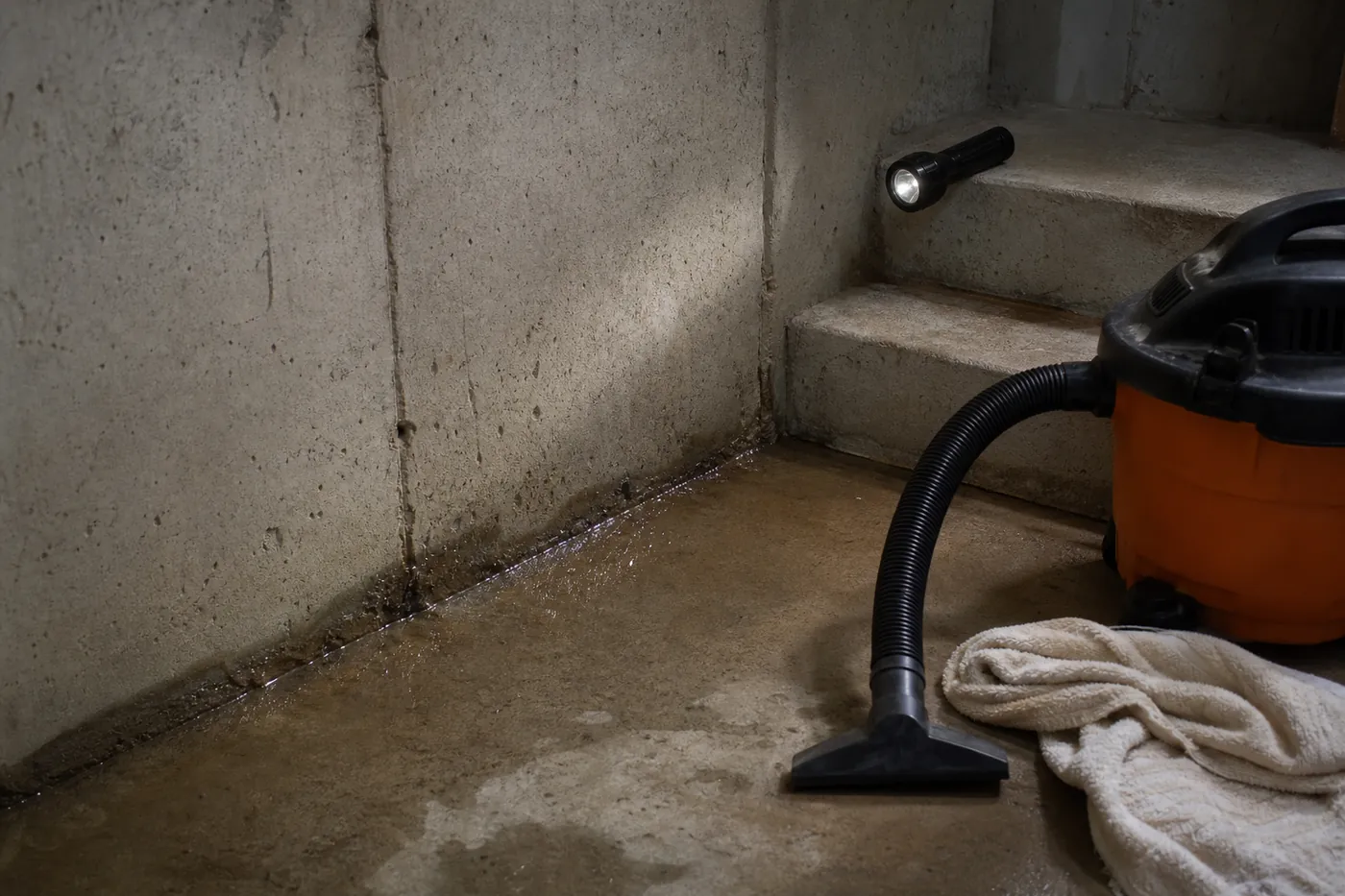
Which Columbus houses cost more to waterproof?
- Houses with no sump at all. The city says homes built before the 1960s tied their foundation drains to the sanitary sewer, and about a quarter of Columbus homes predate 1960 (U.S. Census). Adding a pit means cutting the floor, wiring a dedicated outlet and running a discharge line outside.
- Finished basements. Any finish along the walls being drained, from paneling to carpet, has to be removed first and rebuilt at the end.
- Low lots on Kokomo soils. Where the soil survey shows water at or near the surface in winter and spring, a pump runs more and a backup earns its keep.
- Tight access outside. Exterior work beside a porch, a shared drive or a mature tree costs more to dig and restore.
What a sump pump job costs on its own
Fixr's 2025 guide puts a new installed sump pump at $800–$2,000, with an average of $1,400, while replacing a pump in a pit that already exists runs $350–$1,000. The pit itself is the expensive part where there is none: $500–$1,200 in labor for the basin. Add $150–$250 for a battery backup and $250–$2,000 for a buried discharge line, depending on how far the water has to travel. The sump pump installation page explains each piece.
Columbus permit fees that can land on the bill
The city's 2026 fee schedule for one-, two- and three-family homes lists $275 for a mechanical, electrical or plumbing permit, $275 or $300 for foundation work and $385 for alterations, each including a set number of inspection trips. Building and Zoning Services inspects interior drain tile against the approved plans, and a new outlet for a pump is electrical work. Ask which permits the job needs and whether the bid includes them. Nationally, Fixr lists waterproofing permits anywhere from $75 to $500.
When a city program covers the work
Two city programs carry no direct cost to an eligible homeowner. In active Blueprint Columbus areas, the city may install a sump pump with a battery backup in a single-family home or duplex that has none, using a contractor the city selects. Project Dry Basement covers the basic installation of a backflow prevention device for single- and two-family homes whose sewer backup was reported to the city and traced to rain water in the sanitary sewer. Neither stops seepage through walls. See Blueprint Columbus and Project Dry Basement.
Questions that make two bids comparable
Put each bid on the same footing: which walls and how many linear feet of drain; whether a new pit is dug or an old crock reused; the pump model, a check valve and an alarm; whether a backup is included or priced separately; where the discharge ends and how far from the house; who applies for the Columbus permit and which city license they hold; and the warranty in writing, including whether it passes to the next owner. The specialist who receives a request from this site can go through each point; the request form takes a minute.
Why there is no Columbus price list here
No public agency publishes what Columbus waterproofers charge, and this site does not invent a local figure; the only Columbus numbers above are the city's own permit fees. A bid outside a band is a prompt to ask what the specialist found in your basement, not proof that something is wrong.
Cost questions
Will the City of Columbus pay for a sump pump?
Only through Blueprint Columbus, and only where it applies. The city's brochure says a single-family home or duplex without a sump in an active Blueprint area can apply, city staff decide whether a pump is a cost-effective fit, and there are no direct costs to the homeowner. The city picks the contractor, and you maintain the pump afterward.
Why does digging outside cost so much more?
Because most of the money goes into moving soil, not sealing the wall. This Old House (2026) prices excavation at $50–$200 per cubic yard; its exterior band starts at $7,000 and tops out near $15,000, several times the inside route. Restoring walks, steps and landscaping adds more. Outside work is worth it mainly where the block or concrete face is breaking down.
Does a waterproofing warranty help when I sell?
It can, if it transfers. Ohio's disclosure form asks sellers about past water and any repairs, so a buyer will see that work was done. A written warranty that passes to the next owner, plus the permit record from Building and Zoning Services, answers the next question. Ask about transfer terms before you sign.
What is the basement doing?
Tell it the way you would tell a neighbor: water along the back wall after every downpour, a floor drain that gurgled up in August, no sump pit at all. One independent basement specialist who works around Columbus reads it and gets in touch.